
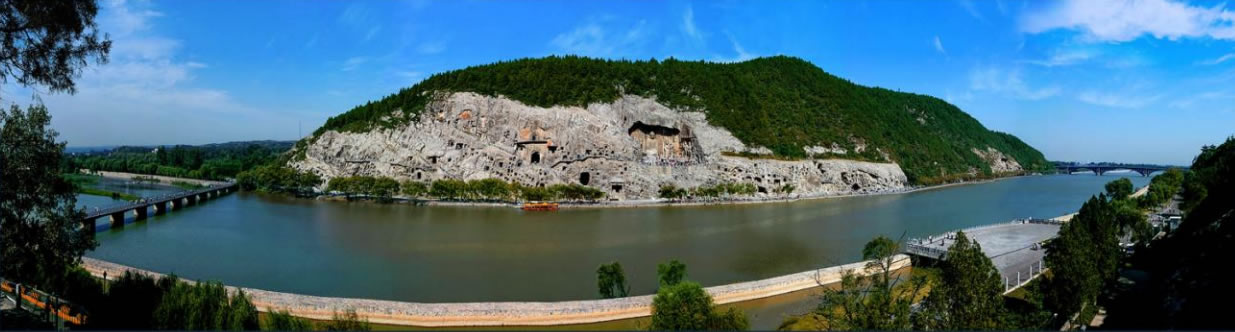
The Longmen Grottoes are located 12 kilometers south of Luoyang City in Henan Province. Here, Xiangshan and Longmen Mountains face each other across the Yi River, which flows between them, resembling a natural gate tower from afar—hence the ancient name "Yi Que." The grottoes are densely distributed along the cliffs on both banks of the Yi River, extending for one kilometer. Their excavation began around the time Emperor Xiaowen of the Northern Wei Dynasty moved the capital to Luoyang. Construction spanned multiple dynasties, including the Northern Wei, Eastern Wei, Western Wei, Northern Qi, Sui, Tang, Five Dynasties, and Song, representing an extensive timeline that witnessed the process of Buddhism’s Sinicization. There are 2,345 extant caves and niches, over 100,000 Buddhist statues, and more than 2,800 stone inscriptions.
The Longmen Grottoes are grand in scale, majestic in momentum, exquisite in carving craftsmanship, and rich in thematic content. They were excavated by distantly inheriting the art of Indian rock-cut caves, closely following the model of the Yungang Grottoes, and merging these with the advanced and profound historical Han Chinese culture of Wei-Jin period Luoyang and the Southern Dynasties. The statuary art of the Longmen Grottoes incorporated, from the outset, an understanding of and strong pursuit for native ethnic aesthetic consciousness and forms. This showed a trend toward sinicization and secularization, making it a "milestone" in the transformation of Chinese grotto art. In 1961, Longmen was designated by the State Council as one of the first batch of Major Historical and Cultural Sites Protected at the National Level.
In 2000, the Longmen Grottoes were inscribed on the UNESCO World Heritage List by the 24th session of the World Heritage Committee. The Committee evaluated them as follows: “The Longmen Grottoes represent the highest peak of Chinese stone carving art from the Northern Wei to the Tang Dynasty. These caves contain the largest and most impressive collection of Chinese art of this period. The sculptures provide exceptional insight into the political, religious, and cultural life of ancient China.”
The stone carvings of the Longmen Grottoes are extraordinarily diverse and varied in form. They encompass statues of Buddhas, Bodhisattvas, disciples, guardian deities, and donors, as well as depictions of the Buddha's life stories, sutra illustrations, architectural elements, and decorative patterns.
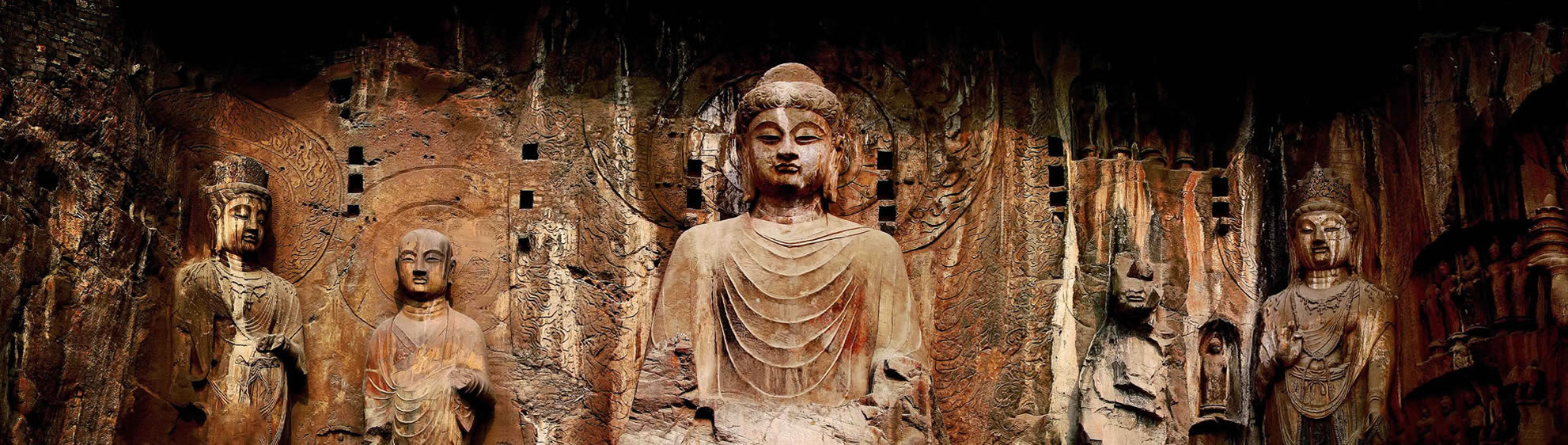
The largest statue, the Vairocana Buddha, stands at an imposing height of 17.14 meters, radiating solemnity and grandeur. In stark contrast, the smallest carvings, located on the southern wall of the Lotus Flower Cave, measure a mere 2 centimeters.
The cave niches are strategically sited and arranged in accordance with the natural mountain slope, creating a harmonious yet dynamic composition that is both intricate and orderly. The grouping and layout of the statues are proportionate and fitting, achieving a harmonious beauty. The sculptures of Buddhas, Bodhisattvas, and disciples are crafted with exceptional skill, capturing both their physical form and spiritual essence, making them remarkably vivid and lifelike.
As an outstanding representative of Buddhist art, the Longmen Grottoes not only embody the devout expression of religious faith but also reflect the political landscape, economic development, and socio-cultural ethos of their time. Within Longmen, one can observe the coexistence and fusion of multiple Buddhist schools. In addition to the statues of the "Buddhas of the Three Periods" featuring Śākyamuni as the principal deity, the Fengxian Temple represents the Huayan School with its main statue of Vairocana Buddha, the Sambhogakāya. The Qianxi Temple, Jingshan Temple, and the Ten-Thousand Buddha Cave exemplify the Pure Land School, centered on Amitābha Buddha. The Leigutai and Wanfogou areas feature esoteric Buddhism, with Vairocana (Mahāvairocana) as the principal deity, the Dharmakāya Buddha. The Kanjing Temple, adorned with 29 arhat statues, represents the Chan School, which venerates Bodhidharma as its first patriarch. Even the most ancient iconic representation, the statue of King Udayana, is present. Furthermore, there are examples of "created" trinities featuring Maitreya as the principal Buddha, such as those in the Cliffside Triad Niche and the Huijian Cave, which were likely crafted for specific political propaganda purposes.
Among the myriad sculptures at the Longmen Grottoes, one can distinctly observe the inheritance, evolution, and stylistic variations of statuary art across different eras, reflecting the cultural values of inclusivity and innovation within Chinese civilization. The Northern Wei sculptures, evolving from the early, rugged, majestic, and mystique-filled "Pingcheng Mode" of the Yungang Grottoes, developed at Longmen into the "Central Plains Mode" characterized by "slender figures with elegant demeanor.." This "Central Plains Mode" pioneered at Longmen once spread and flourished widely across grotto sites throughout China.
The Tang Dynasty sculptures inherited the Northern Wei tradition while infusing it with greater elements of secular Han Chinese art. The sculptural style became more realistic, natural, and rich in human touch. For instance, the statue of Amitabha Buddha in the Qianxi Cave, with its full and gentle face, appears both dignified and approachable. The attendant Bodhisattvas on the northern and southern walls, adorned in long, wide-sleeved robes and possessing full, graceful figures, are classic embodiments of this secularized artistic style. They represent mature artistic treasures within Tang stone carving.
The Longmen Grottoes preserve a vast collection of material historical evidence related to religion, fine arts, architecture, calligraphy, music, costume, and medicine, making it veritably a large-scale open-air museum of stone carving art. Many ancient Chinese musical instruments have been lost over time, but their forms can still be seen depicted in the sculptures at Longmen, such as the Konghou(an ancient Chinese harp), Bili(a double-reed wind instrument), and Jilougu(a type of drum held under the arm). Furthermore, numerous images of celestial musicians and dancers and human musicians are preserved in caves like the Guyang Cave, Binyang Cave, Bazhuosi Cave, and the Southernmost Cave, reflecting various aspects of the period's music and dance.
The Northern Wei Dynasty was a crucial era that bridged the musical traditions of the Qin and Han dynasties with the subsequent development of music during the Sui and Tang. The Tang Dynasty, in particular, was a flourishing period marked by the fusion of Han and Central Asian music, often regarded as the golden age of ancient Chinese musical culture, and evidence for all this can be found at Longmen. The Prescriptions Cave at Longmen contains the earliest known carved stone medical prescriptions in China. Research confirms these prescriptions date from the Tang Dynasty, fully demonstrating the outstanding achievements in ancient Chinese medicine over a millennium ago. Their contents were later recorded in the Japanese medical text Ishinpō, highlighting the early international transmission and influence of traditional Chinese medicine.
Longmen Grottoes preserve 2,800 inscribed tablets and steles, a feature unique among China's grotto complexes. Due to this exceptional concentration, the site is also known as the "Forest of Ancient Steles." These inscriptions provide irreplaceable material evidence for studying ancient societies, cultural exchanges, and the evolution of Chinese calligraphy.
Historical records and the inscriptions themselves reveal that the patrons behind the grottoes included the imperial family, aristocracy, local guilds, common devotees, and even a small number of foreign Buddhists. Among the most celebrated calligraphic treasures are the "Twenty Calligraphic Masterpieces from Longmen"(Longmen Ershipin), a selection of Northern Wei inscription captions exemplifying the Wei Tablet Style(Weibei). This style is historically significant for bridging the clerical script of the Han and the standard script of the Tang.
Furthermore, the "Stele of the Buddhist Shrine in Yique" (Yique Fokan Bei), whose text was calligraphed by the renowned Tang master Chu Suiliang, along with the "Stele Inscription of the Great Vairocana Niche"(Da Lushena Xiangkan Ji Bei), added during the Kaiyuan era (722 AD), stand as representative masterpieces of early and high Tang calligraphic art.
Representative caves from the Northern Wei period at Longmen include Guyang Cave, Binyang Middle Cave, Lotus Cave, the cave with the "Wei" character inscription, and Huangfugong Cave. Northern Wei statues are characterized by slender figures, elegant demeanor, wide robes and large sleeves, gentle expressions, and an air of grace and freedom. Tang Dynasty statues at Longmen evolved into a style featuring plump bodies, full chests and slender waists, rounded faces, and dignified elegance. Representative caves include Qianxisi Grotto, Fengxian Temple, Ten-Thousand-Buddha Cave, Jinan Cave, and Kanjingsi Grotto on the East Hill. Both the Northern Wei and Tang periods represent paradigms of Eastern artistic charm.
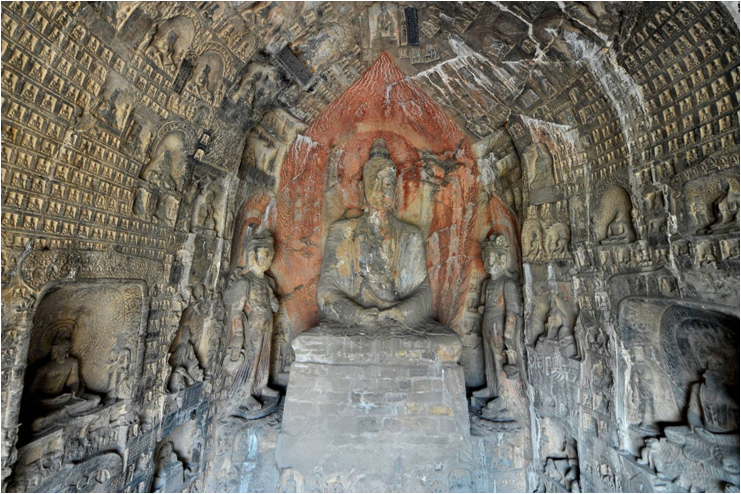
The Guyang Cave, situated in the southern section of the West Hill, was constructed based on a natural karst cave. It measures 11.2 meters in height, 7.27 meters in width, and 11.83 meters in depth. As the earliest excavated, most richly carved, and most extensively inscribed large-scale cave at the Longmen Grottoes, it houses over 1,500 niches and more than 800 inscribed stone tablets, holding immense historical, cultural, and calligraphic value. Nineteen of the renowned "Twenty Calligraphic Masterpieces of Longmen" — highly esteemed examples of Northern Wei script admired by epigraphers and calligraphers — are located in this cave.
The main statue in the Guyang Cave is a depiction of Sakyamuni Buddha, approximately 6.1 meters tall, seated in the lotus position (vajrasana) on a rectangular pedestal. The Buddha has an elongated, serene face and his hands are formed in the dhyana (meditation) mudra. Two bodhisattvas stand attentively on either side, their postures graceful and seemingly dynamic. Adorned with jeweled crowns and delicate features, their overall style marks a transition from the early Northern Wei's robust and powerful “Pingcheng Style” to the “slender figures and elegant demeanor” aesthetic. The facial expressions shift from severity to gentleness, evoking a sense of approachability. In attire, the form-fitting clothing is replaced by long skirts and wide sleeves, characteristic of the looser, belt-fastened robes (baoyi bodai) of scholars.
On the northern and southern walls of the cave, three tiers of niches are carved. These niches house a variety of statues, including:
· Seated Sakyamuni Buddha figures wearing robes that bare the right shoulder.
· Maitreya Bodhisattva figures depicted with the upper body exposed, wearing a skirt, and seated cross-legged in a "lalitasana" pose in front of a lion throne.
· Paired seated figures of Sakyamuni and Prabhutaratna Buddha, both adorned in the loose, wide-sleeved robes and broad sashes characteristic of the period.
The statues, varying in size, are elegantly shaped, while the lintels of the niches and the intricately detailed mandorlas (aureoles) behind the Buddha figures are exquisitely crafted and ornate. The cave also contains the most complete series of scenes depicting the Buddha's life story found at the Longmen Grottoes. These include key events such as Queen Maya's dream of the white elephant, the Buddha's birth under the tree, the child Buddha taking his first seven steps with a lotus blooming at each step, and the ritual bath performed by the nine dragons.
The Middle Binyang Cave was commissioned by Emperor Xuanwu of the Northern Wei as a merit-making cave for his parents, Emperor Xiaowen and Empress Wenzhao. It is one of the most representative imperial caves of the Northern Wei period at Longmen. Excavation began in the 1st year of the Jingming era (500 AD) and was completed in the 4th year of the Zhengguang era (523 AD) of the Northern Wei. Initially started high on the cliff face in 500 AD, work was moved to the current, lower location in 505 AD due to the difficulty of cutting the rock too high up. Completion took about 24 years, consuming 802,366 workdays. The interior is lavishly decorated, with a canopy carved on the ceiling and a lotus pond pattern on the floor. The "Empress and Attendants Worshipping the Buddha" scenes on the side walls of the entrance passage are vivid depictions of contemporary court life, ceremonial practices, and Buddhist activities.
There are 11 large statues in total: a main group of 5 on the rear wall and one group of 3 on each of the south and north walls, representing the Buddhas of the Past, Present, and Future. The main statue on the rear wall is Shakyamuni Buddha, wearing the loose, belted monastic robe, seated in lotus posture, with a high nose, large eyes, and a slight smile. On either side of Shakyamuni stand two disciples and two Bodhisattvas, gentle and dignified. The statue groups on the south and north walls each consist of one Buddha and two Bodhisattvas, all wearing the loose, belted robes, standing on lotus bases.
The statues within the niches have slender bodies, thin faces, long necks, and serene expressions, with slightly upturned corners of the mouth suggesting a smile. The attire also changed from the Yungang style of robes leaving the right shoulder exposed to the wide-sleeved monastic robe, with drapery carved in a flowing, cloud-like manner. This is the typical "slender figures with elegant demeanor" and "loose robes with wide belts" style. The formation of this style in the Binyang Middle Cave fully demonstrates the changes in grotto statuary style after Emperor Xiaowen's sinicization reforms, making it a typical representative of sinicized caves from the Northern Wei period at Longmen. The "Procession of the Empress" scenes were grand in scale, meticulously detailing the figures, rituals, objects, and atmosphere, but unfortunately, these reliefs were stolen in earlier times.
The Middle Binyang Cave was uniformly planned and executed in one go, seamlessly integrated from top to bottom, symmetrically balanced left and right, with a rigorous layout and majestic momentum. It is a gorgeous and magnificent grotto work embodying the imperial style of the Northern Wei period.
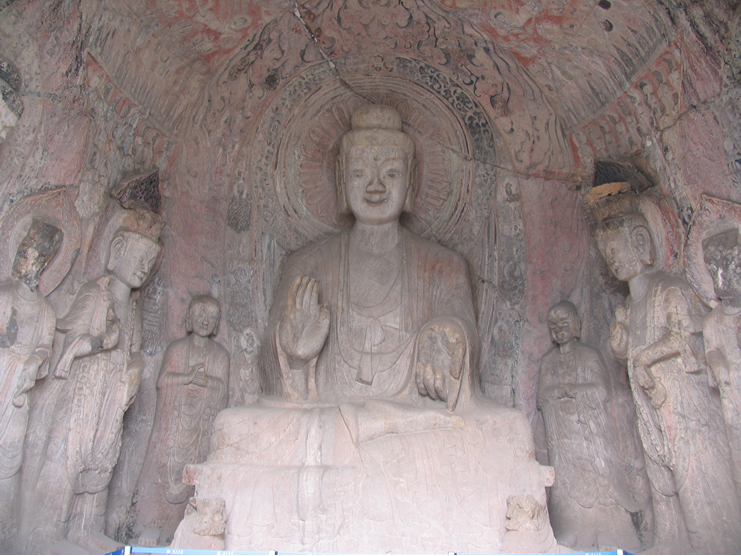
The Lotus Cave is 5.9 meters high, 6.22 meters wide, and 9.78 meters deep, named after the high-relief lotus flower carved on its ceiling. It contains over 200 large and small niches with rich content and exquisite carving. The main composition is one Buddha, two disciples, and two Bodhisattvas. The main Buddha is a standing statue of Shakyamuni in a preaching posture during his travels. Shakyamuni wears the loose, belted monastic robe. The two disciples beside him are Kasyapa and Ananda. Kasyapa, depicted as an ascetic monk, wears a heavy monastic robe and holds a staff—this is the only instance of a staff-holding image at Longmen. Ananda on the south side holds a lotus bud in his left hand, his right hand placed on his chest, appearing steady and sincere. The two Bodhisattvas stand on round lotus pedestals. On the north and south walls of the cave, many small niches and Buddhist story scenes are carved, mostly depicting “Debates between Vimalakirti and Manjusri,” along with stories of Shakyamuni meditating under the Bodhi tree and preaching the Dharma.
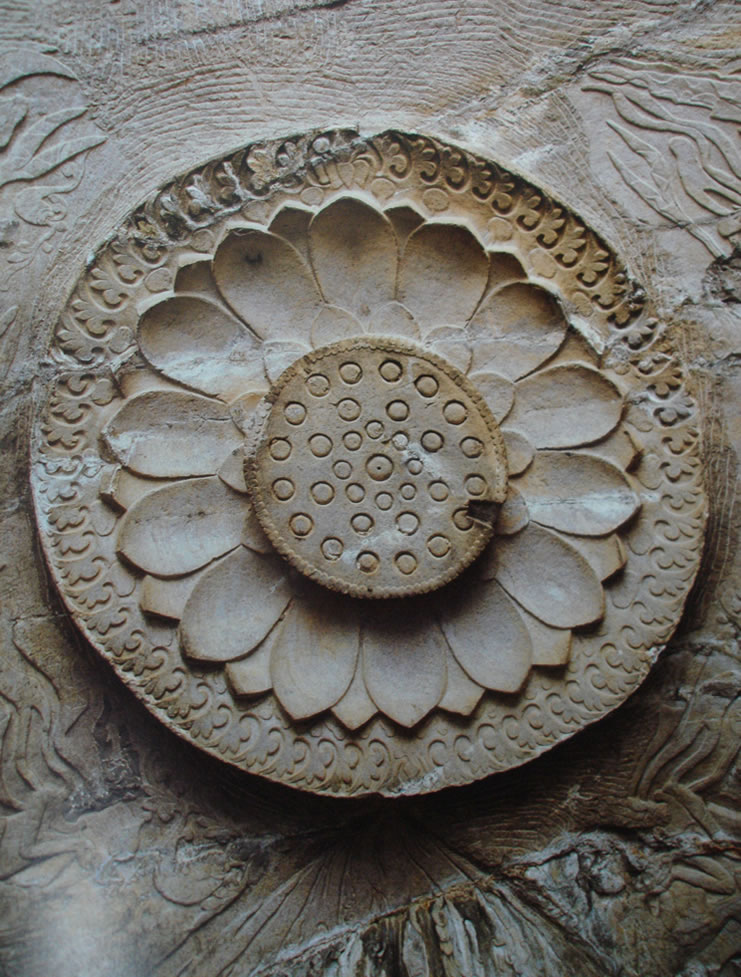
This cave was excavated by Huangfu Du, a high-ranking official (Defender-in-Chief) of the Northern Wei. Huangfu Du was the maternal uncle of Empress Dowager Hu of Emperor Xiaoming of the Northern Wei. Using his power, he amassed great wealth, enabling him to create such a splendid cave. The lintel is carved in imitation of a wooden cave eave, with a Kalavinka bird at the center of the roof ridge and owl-tail ornaments at both ends. The cave entrance has lotus-shaped door pillars, with a powerful guardian figure over 2 meters tall carved on each side. The ceiling inside features a lotus caisson (decorated ceiling panel) surrounded by eight flying Apsaras holding musical instruments. The main deity in the niche on the rear wall is a Shakyamuni Buddha over 3 meters high, whose face is damaged. Notably, his left hand is carved with six fingers, the meaning of which remains a mystery. Flanking him are two disciples, two Bodhisattvas, and two semi-seated Bodhisattvas with one leg pendent. Their size is only one-fifth that of the main Buddha, clearly intended to emphasize the main image. Next to the semi-seated Bodhisattvas, a Bodhi tree is carved in relief, with lush branches and leaves, forming a complete “Meditation under the Tree” scene.
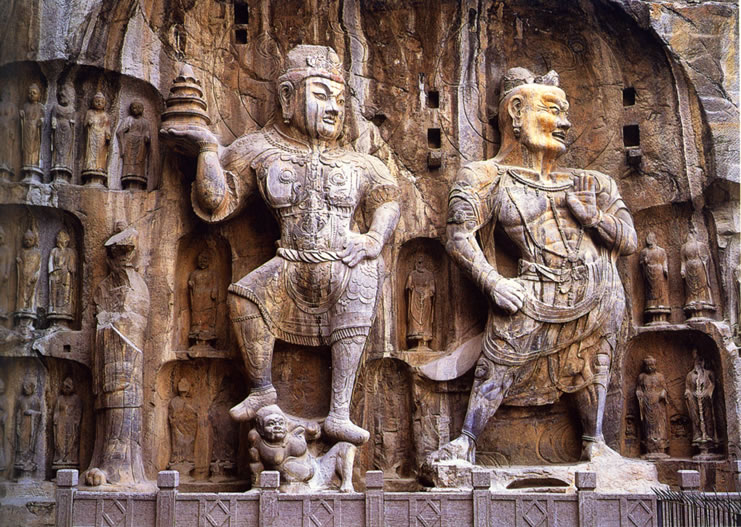
The Fengxian Temple is the largest group of cliff-side niches at Longmen and represents the pinnacle of extant Tang Dynasty stone carving art in China, built during Emperor Gaozong's reign. The Vairocana Buddha Niche is roughly horseshoe-shaped, encircling the north, west, and south walls, with a recessed base platform. On the platform are carved nine large statues: one Buddha, two disciples, two Bodhisattvas, two Heavenly Kings, and two Guardians. The Vairocana Buddha is 17.14 meters tall, with a head height of 4 meters and ears 1.9 meters long, seated in lotus posture on a sumptuous throne. The entire statue is solemn, elegant, wise, and compassionate. The disciples flanking the main Buddha: on the left is Kasyapa, depicted as an elderly, weathered figure; on the right is Ananda, with a rounded, gentle, and delicate face, clearly a docile young figure. The attendant Bodhisattvas, Manjusri on the left and Samantabhadra on the right, are both about 13 meters tall, exquisitely carved and ornately decorated. The guardian Heavenly Kings on left and right are also over 10 meters tall. The left is Vaisravana (North) and the right is Virudhaka (South), portrayed as solid, resolute, serious, and calm, emphasizing the imposing manner and strength expected as defenders of the Dharma. The outermost Guardian figures scowl with anger, mouths open in a shout, with bulging muscles carved to depict strong warrior images.
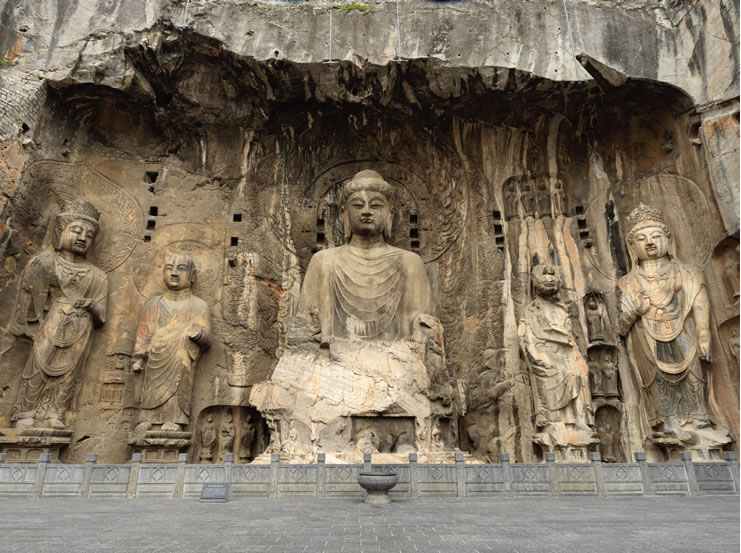
This group of statues in the Vairocana Buddha has a clear hierarchy, distinction in height, and a balance of strength and gentleness. It is immensely powerful, maximally projecting Buddhist spirit and displaying the grand imperial style of Tang Dynasty grottoes. Its scale, artistic accomplishment, and carving technique represent the highest achievement of Tang Dynasty sculptural art. It embodies extraordinary artistic value, profound historical significance, rich cultural connotations, and wide influence, earning high praise and respect worldwide.
The Qianxi Temple is the first large cave at the northern end of the West Hill, excavated during Emperor Gaozong of Tang's reign. The ceiling is carved with a shallow large lotus flower. It houses seven large statues: the main deity Amitabha Buddha, the disciples Kasyapa and Ananda, the Bodhisattvas Avalokiteshvara and Mahasthamaprapta, and two Guardian Kings—a typical Tang Dynasty representation of the "Western Trinity" (Sukhavati). The main Buddha, Amitabha, sits in lotus posture on a throne, with full cheeks, a prominent chest, well-proportioned form, and a compassionate, wise expression. The Avalokiteshvara Bodhisattva on the left (north wall) wears a high crown bearing a transformed Buddha image, a shawl, and jewels, holding a pure vase in the left hand and a fly-whisk (chowrie) over the right shoulder. The Mahasthamaprapta Bodhisattva on the right (south wall) is plump, solid, and serene in demeanor. The Guardian Kings on the side walls of the front chamber wear armor and have powerful physiques, resembling valiant Tang generals; even the demon figures under their feet are vividly rendered.
This is a typical Tang Dynasty Pure Land School cave dedicated to the "Western Trinity," named for the 15,000 small Buddha figures covering its walls. The ceiling has a lotus caisson, around which is inscribed in regular script: "Completed on the 30th day of the 11th month of the Yonglong 1st year of the Great Tang (680 AD), by the Great Overseer Yao Shenbiao and the Meditation Master Yun of the Inner Chapel." It is a typical imperial cave with a clearly recorded completion date. There are seven large statues: the main deity Amitabha Buddha on the west wall, seated in lotus posture on a sumptuous octagonal lotus throne, with a full, rounded, serene face, an urna (forehead mark), and three lines on the neck. Flanking Amitabha are two disciples, two Bodhisattvas, and two Heavenly Kings. The left disciple Kasyapa appears experienced and steady; the right disciple Ananda, gentle and devout; the two Bodhisattvas are graceful and ornate; the two Heavenly Kings wear armor, trample demons, and look mighty and imposing. Above the main Buddha is a relief of "One Buddha with Fifty Bodhisattvas," with lotus stems connecting over 50 lotus flowers, each bearing a Bodhisattva in a different pose and expression—a unique design showing a "Lotus Pure Land" of the Western Paradise. They complement the 15,000 small Buddhas on the north and south walls, enhancing the Buddha's allure.
On the south wall of the antechamber, there is a niche containing an image of Avalokiteshvara, 85 cm tall, with a graceful figure and extraordinary elegance, traditionally regarded as the most beautiful Guanyin at Longmen. An inscription dates it to 681 AD, dedicated by a nun. Unfortunately, the face is damaged. The Longmen Grottoes Research Institute has conducted virtual reconstructions and digital presentations using historical photos, 3D scanning, and artistic expertise.
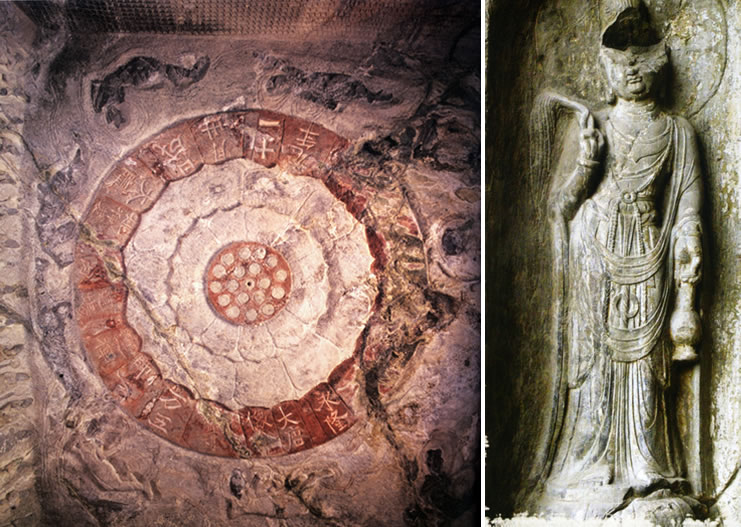
Named for its location at the southernmost end of the West Hill, this cave was excavated around the period from Emperor Zhongzong's Shenlong era to Emperor Ruizong's Jingyun era (early 8th century) by the famous Tang chancellor Yao Chong in memory of his deceased mother, Lady Liu. It is a Maitreya Pure Land cave. Outside the entrance are artistically sculpted guardian figures, though the head of the northern one is damaged. Inside, a Buddha platform runs along three walls. The main statue is Maitreya Buddha, seated on a waisted square throne, with a long, full face, downcast eyes, long earlobes, and well-balanced proportions—a fine example of Tang Maitreya statues. Attendants include two disciples, two Bodhisattvas, two Heavenly Kings, and one of the Eight Classes of Dharma Protectors with a human face and animal body. The platform also has square panels containing reliefs of musician figures: two dancers on the rear wall, and musicians on the left and right holding instruments like the konghou, bili, cymbals, lute, drum, sheng, and Chinese traditional round fan, depicting a vibrant Tang music and dance scene.
Located on the north side of Wanfogou on the East Hill, this is the largest cave on the East Hill, excavated around Empress Wu Zetian’s time. The cave has front and rear chambers. The ceiling has a lotus caisson with six flying Apsaras. The rear wall lacks a main image; a platform in the center now holds a statue moved from elsewhere. Along the base of the east, south, and north walls are 29 life-size (approx. 1.8m) Arhat relief sculptures, each with distinct expressions and vivid features. According to the Sui Dynasty text The Records of Precious Dharma Treasures Through the Ages, after Shakyamuni's Nirvana, the Dharma was transmitted to Mahakasyapa, and then through a lineage. The Kanjingsi Cave likely arranges the Arhats according to this transmission genealogy.
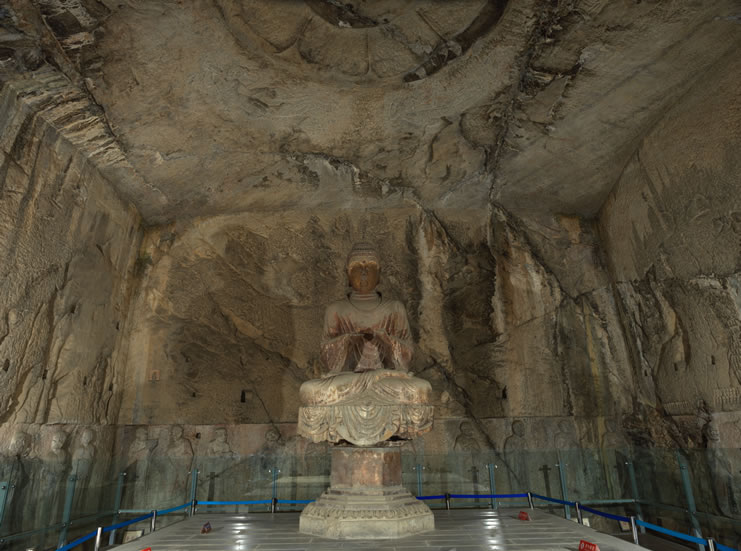
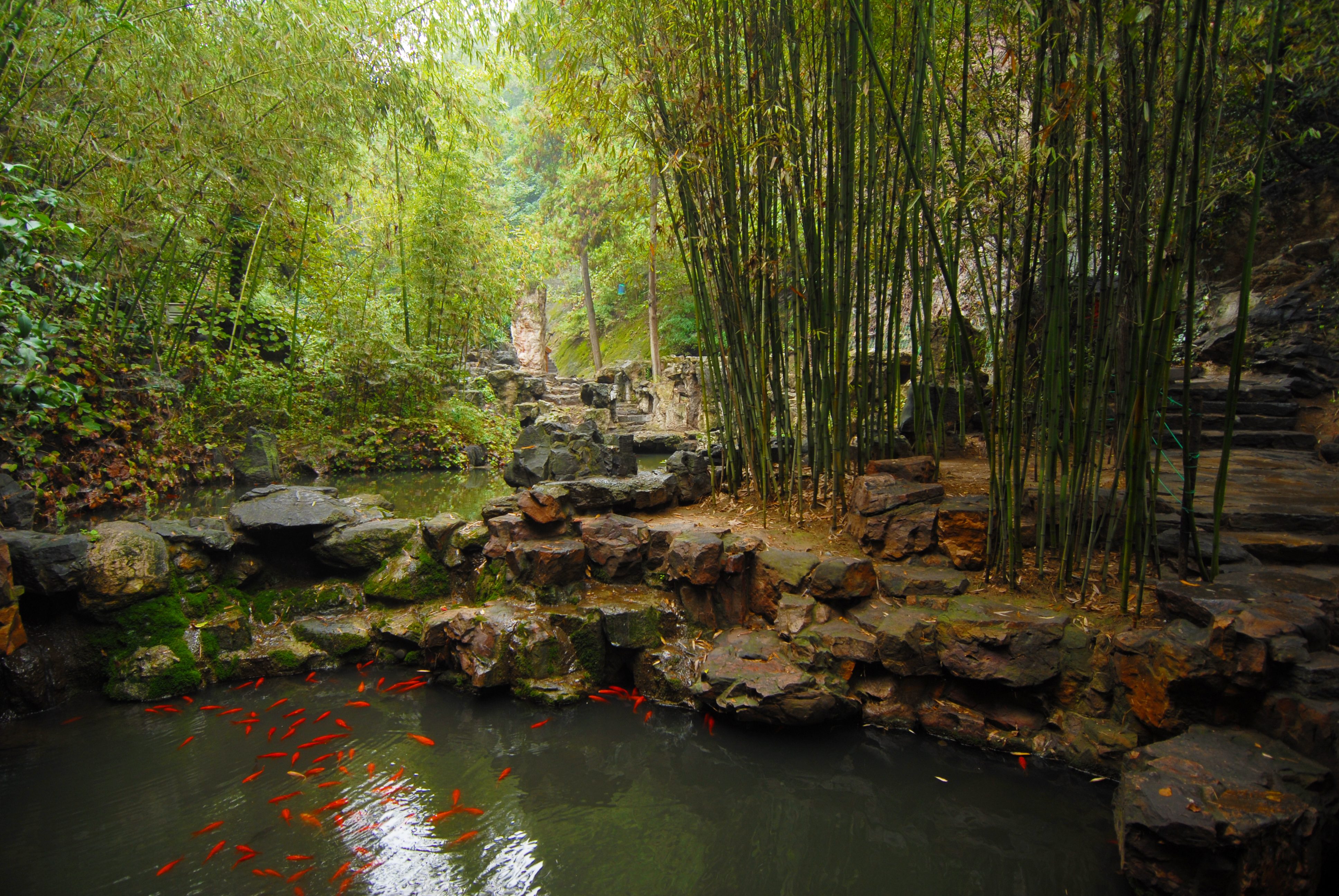
Situated on the slopes of the East Hill, facing the West Hill grottoes across the river and adjacent to Bai Garden, Xiangshan Temple has a history of over 1,400 years. Its architecture is simple and robust, nestled among pines and cypresses. A gathering place for literati with continuous incense burning, it possesses profound cultural depth.
In 690 AD, Wu Sansi petitioned Empress Wu Zetian to renovate the temple, formally naming it "Xiangshan Temple." In 832 AD, the poet Bai Juyi donated funds earned from writing an epitaph for his friend Yuan Zhen to repair the temple and wrote Record of Repairing the Xiangshan Temple. The fame of the celebrity, the famous mountain, and the famous temple enhanced each other. Bai Juyi also compiled 800 poems written during his 18 years in Luoyang into a ten-volume collection titled Bai's Luoyang Collection.
In September 1750, Emperor Qianlong visited the temple during a tour, composed two poems praising it, the first line being "Among the ten temples at Longmen, the first is counted Xiangshan." The poem was inscribed on a stele for which a pavilion was built, located in the southeast corner of the temple grounds.
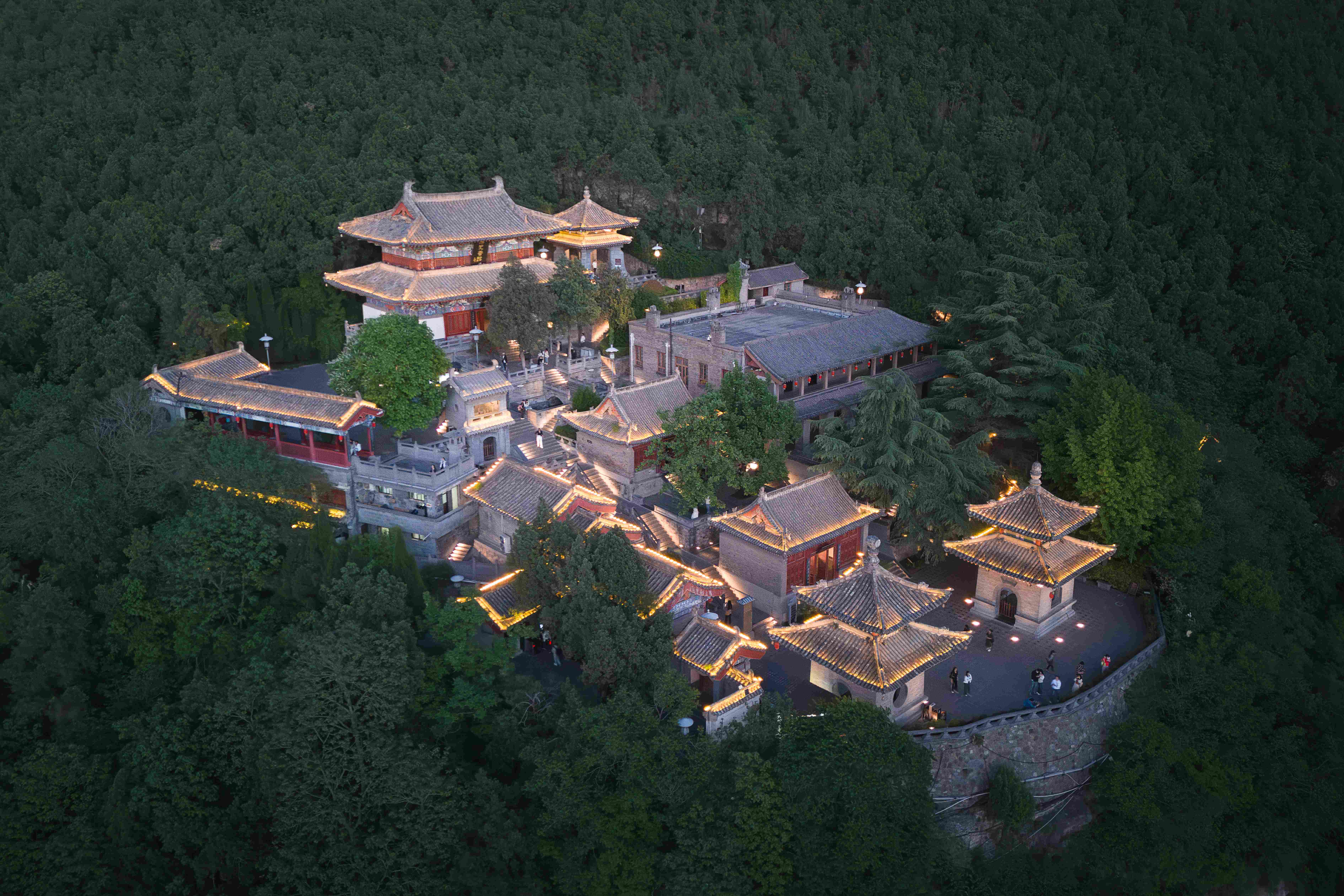
This is the tomb garden of the Tang poet Bai Juyi. Located at the northern end of the East Hill beneath Pipa Peak, entering the Baiyuan Garden and climbing over 150 winding steps leads to the summit. Bai Juyi lived his later years in Luoyang for 18 years, developing a deep affection for the scenic landscape of Longmen. To make the hazardous Bajietan section of the Yi River navigable, he raised funds at age 73, successfully calming the waters.